
A Private Members Association for discriminating luxury leather bag lovers
Free shipping within the United States
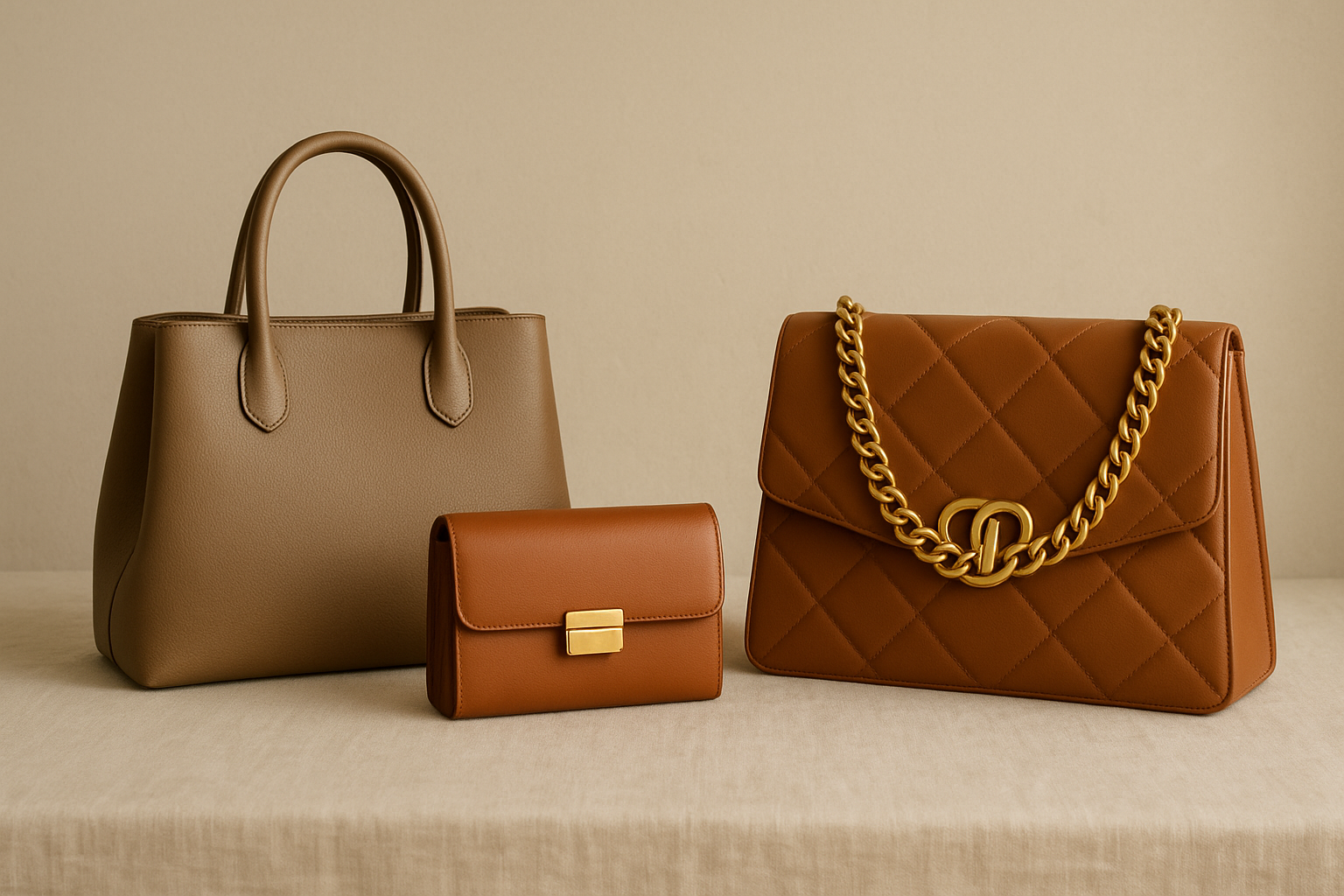
She stands in her dressing room—a woman of careful taste and considered acquisitions. The bags arranged on the shelves are, by any objective measure, lovely. Some are old, their leather softened into a map of past journeys; others are newer, their surfaces still unyielding. A few bear names that whisper of status. Yet as she contemplates the day ahead—a morning meeting, a friend’s lunch, an evening lecture—her hand passes over each one, landing on none of them.
The problem isn’t a lack of beauty. It’s a surplus of almost-rightness.
The corporate tote from her former life feels like a monument to a self she no longer is. The elegant shoulder bag, perfect for a gallery opening, bites into her shoulder when carried through a day of errands, leaving a dull, accusatory ache by afternoon. The practical crossbody that never fails her on trips seems to shrink her at a dinner party, making her look, for lack of a better word,…accommodating. As if the bag were the main event, and she merely its weary porter.
It’s a heretical thought to entertain in a culture of accumulation, but she’s beginning to suspect the truth: the flaw lies not in the bags, but in a fundamental miscalibration. Somewhere between falling in love with objects and building a functional life, she collected promises of elegance that their proportions couldn’t keep.
This isn’t a failure of taste. It’s the quiet revelation of experience: that true luxury isn’t about possession, but about precision. The right bag isn’t just beautiful or well-made—it’s a piece of dimensional algebra that solves for the body carrying it and the life being lived. When it works, you forget it’s there. It simply works.
The math, of course, is deceptively simple. A bag that suits a woman five foot ten will engulf someone eight inches shorter, no matter how fine the leather. A bag sized for a day of professional demands becomes a clumsy companion at a dinner party. The dimensions that felt like liberation at forty can feel like a burden at sixty, when shoulders tell different stories and priorities tilt toward ease.
I make bags for a living. I cut leather, place stitches, and puzzle over the architecture of interior space. And I can tell you the most common error I see: it’s rarely a poorly made bag. It’s a beautifully made bag in the wrong dimensions. An exquisite object, sized incorrectly for your frame or purpose, will betray you in a hundred small ways. It will alter your posture, shift its weight like a restless child, hide your keys in unreachable corners. It will send signals you never intended—disorganization when you are meticulous, effort when you want to project ease.
The equation we’re trying to solve—the one for everyday elegance—has three variables that must work in concert. The dimensions must suit the architecture of your body, serve the actual requirements of your life, and fulfill the specific purpose of that particular day. Get two right, and you have a bag that almost works. Get all three, and you have something else entirely: a bag that disappears into a kind of perfect, silent rightness.
This is what we’re here to discuss. Not how to replace your collection—though you may find, as we go, that some pieces reveal themselves as beautiful mistakes. But how to understand what’s genuinely missing. How to spot the real gaps, not the ones invented by a market that profits from your uncertainty.
Because here is what I’ve learned from my work and the women who carry my bags: the goal isn’t to own many bags. It’s to own the right ones. To curate a small collection where every piece has earned its keep through utility and proportion, where nothing is kept out of guilt or faded aspiration.
A collection like that—small, intentional, perfectly calibrated to your life—requires a skill most of us were never taught: how to assess dimension as carefully as we assess leather and stitch. To treat size not as an afterthought, but as the foundation.
So let’s start there, with the uncomfortable truth that we’ve been shopping backward—seduced first by beauty or a name, and only later discovering if the proportions serve us. Let’s consider the liberation of reversing that order: beginning with dimensional honesty, and letting aesthetics follow.
The result, I think you’ll find, isn’t limiting. It’s clarifying. When you know your own equation—your proportions, your purposes—the vast world of bags becomes navigable. You stop seeing everything as potentially right and start seeing clearly what is actually right for you.
And that clarity, more than any bag, is what lets you move through the world with an ease that looks effortless because it finally is.
There’s a peculiar fiction we’ve all agreed to believe: that a bag designed in one size—let’s say, fourteen inches wide—will somehow serve a woman who stands five foot two with the same grace it offers a woman five foot ten. That proportion is a universal language, requiring no translation for the infinite dialects of the human body.
It’s nonsense, of course. We would never apply this logic to clothing. A jacket cut for a tall frame would drape a shorter one like a costume, the shoulders sagging, the sleeves swallowing her hands. We know, instinctively, that a garment must harmonize with the body beneath it.
Yet with bags, we suspend this understanding. We accept the dimensions a designer has chosen—based on some imagined average or aesthetic whim—and contort ourselves to fit them. We hike a strap, adjust our gait, and carry a bag that overwhelms our frame because it bears a name we admire. We tell ourselves we’ll “make it work,” as if elegance were a matter of determination rather than simple mathematics.
The truth is less forgiving: a bag’s dimensions are as critical to its success as its materials. Perhaps moreso. A poorly proportioned bag, no matter how exquisitely crafted, is a constant, low-grade complaint. It requires adjustment. It creates a visual static. It refuses to be forgotten.
I understand why the fiction persists. Bags are designed to specific dimensions for good reason. Structure, aesthetic balance, the physics of construction—a bag isn’t infinitely scalable. You can’t just shrink a design by twenty percent without throwing its entire geometry into discord. The strap width must correspond to the weight it will bear. The height must balance the depth. Changing one measurement without adjusting the others is like trying to shorten a piano without re-stringing it.
So the bags you find—mine included—arrive with their proportions already set. This isn’t a limitation; it’s a matter of design integrity. The question isn’t whether you can change the bag, but whether you can find the bags already designed for a woman with your proportions.
And this is where we tend to go wrong. We fall in love with the idea of a bag first. The leather feels like butter, the hardware winks at us, the shape promises a version of ourselves we wish to become. Only later, once we’re already emotionally invested, do we ask the practical question: But does it actually work for my body? My life?
I’ve watched this drama unfold countless times. A client adores a design. The color is perfect, the leather sublime. But when she carries it, the dimensions are fundamentally at odds with her frame. It’s too large, making her look like she’s in permanent transit. Or the strap hits her hip at that awkward spot that requires a constant, subconscious hike of the shoulder.
Still, because it’s beautiful and expensive, she perseveres. She adjusts her posture. She shifts the weight from one shoulder to the other. She tells herself she’ll grow into it, that she’s being too fussy.
Of course, the bag never stops being wrong. Eventually, it is exiled to a shelf, where it remains—a beautiful, well-made monument to a mismatch.
This is the uncomfortable truth about “one size fits most”: it usually fits no one particularly well. The bag designed for an average will be wrong for anyone outside that statistical phantom—which is almost everyone.
But there’s a deeper layer, one I learned from watching how women actually live with their bags: even a bag that suits your frame can be wrong for your purpose. The bag that’s perfect for a day at the office, holding your tablet and documents, will feel like a piece of luggage at a dinner party. The bag that’s exquisitely proportioned for evening will be a source of frustration on a Saturday full of errands.
This isn’t the bag’s failure. It’s a failure to acknowledge that different dimensions serve different purposes. The woman who searches for one “versatile” bag to rule them all often ends up with a bag that’s a master of none—too large for some occasions, too small for others, a perpetual compromise.
When women write to me about customizing a design, I have to explain that while I can change almost everything—the leather, the color, the hardware—the fundamental proportions are the soul of the bag. They are not arbitrary. To alter them is to create a different object entirely.
Better, I’ve found, to help someone find a bag that already exists in dimensions that serve her, rather than trying to force a design into a role it was never meant to play.
Your work, then, is to understand your own proportions so well that you can walk away from a beautiful bag that’s wrong for you. It requires a discipline that runs counter to everything we’re taught about consumption. We’re encouraged to follow desire, to acquire what calls to us. But elegant dressing—the kind that looks effortless because it is—demands a more rigorous question. Not just “Do I love this?” but “Will this love me back?” Not “Is it beautiful?” but “Are its beauties the ones that work with my body and my life?”
These are harder questions. They demand that we know ourselves—our measurements, our habits, our daily realities—well enough to act as our own most discerning critic. They require accepting that not every beautiful object is destined for us, and that true elegance emerges from precision, not accumulation.
It means being willing to wait for the bag that isn’t just appealing, but correct. Because that bag—the one scaled for your frame, dimensioned for its purpose, so right it disappears from your consciousness—that bag is worth a closet full of beautiful mistakes.
Most of us, when considering a new bag, start with aesthetics. Is it beautiful? Does it reflect my style?
These aren’t bad questions. I ask them myself. But they’re like admiring the curtains in a house before checking if the roof leaks. They start at the wrong end of the problem.
Before we fall in love with a leather or a clasp, there’s a more fundamental question we must answer: What is this bag actually for?
We’ve been trained by marketing and magazines to think of bags as generalists. We chase the mythical “perfect everyday bag,” the one that will glide seamlessly from boardroom to dinner to weekend market, holding everything we might possibly need while never looking overstuffed or burdensome.
I’ve searched for this bag. You probably have, too.
It doesn’t exist.
Or rather, it exists as a collection of compromises dressed up as versatility. Large enough for work, and therefore too substantial for a party. Structured enough for authority, and therefore too formal for a Saturday. It’s the handbag equivalent of a Swiss Army knife with forty-seven attachments: impressive in theory, frustrating in practice, and always missing the one tool you actually need.
The liberating, if uncomfortable, truth is this: different purposes demand different dimensions. A bag sized for a day of professional demands will be comically out of place at an evening event. We understand this intuitively about everything else. You wouldn’t wear the same shoes to run a marathon and get married. Yet with bags, we expect a single object to navigate every context of a complex life with equal grace.
I’ve come to think in terms of three categories, each with its own dimensional logic: the Daily, the Occasional, and the Statement. These aren’t rigid boxes—your life may demand different divisions—but they offer a framework for thinking about how size serves purpose.
This is the bag for the ordinary, necessary days. The commutes, the meetings, the errands that constitute the marrow of a week.
It carries what you genuinely need to function. Not what you might need in some theoretical emergency, but what you actually use. Your wallet, your phone, your keys. Perhaps a tablet. Reading glasses, if, like me, you’ve reached the age where they appear unbidden, like an uninvited but persistent guest. The book you’re actually reading.
The Daily bag must achieve a kind of Goldilocks balance: genuine capacity without becoming a burden. Too small, and you’re engaged in a constant, frustrating game of Tetris with your belongings. Too large, and you become a pack mule for “just in case” items, hauling around the physical weight of your anxieties. Your shoulder aches by mid-afternoon, your posture tilts, and you project an air of disorganization even if you could locate any item in the dark.
The Daily bag typically lives in the range of thirteen to fifteen inches wide, ten to twelve high, four to six deep. But these are observations, not commandments. Your ideal size depends entirely on your frame and your actual, honest contents.
Which brings us to the most revealing exercise: the lifestyle audit.
Empty your current daily bag. Right now. Lay everything on a table and look at it with the cold eye of an accountant. When did you last use each item? How much of what you carry is genuine necessity, and how much is insurance against a disaster that never arrives?
Most women discover, with a mixture of surprise and chagrin, that they’ve been carrying far more than their lives require. The relief of rightsizing is immediate. Your shoulder stops complaining. You move through the world with less effort.
But a good Daily bag must also maintain its composure when it’s not full. A soft, unstructured bag will sag like a deflated balloon when half-empty, apologizing for its own existence. A well-designed one has enough architecture to hold its shape with dignity, whether it’s carrying your full suite of tools or just the essentials for a quick errand.
Then there are the events that exist outside the daily routine. The dinner party, the gallery opening, the concert.
These occasions demand a different kind of presence. The bag that serves you so well during the day will feel all wrong here—too substantial, too businesslike, a reminder of the world of obligations you’ve supposedly left behind.
The Occasional bag is typically smaller. Ten to twelve inches wide, seven to nine high, three to four deep. It carries only the essentials: a slim wallet, a phone, keys, lipstick.
Its purpose isn’t capacity, but a statement: I am here for this. I am unencumbered. I have not confused a social event with a workday.
But this is where many women make a crucial mistake: smaller does not mean non-functional. I’ve seen too many evening bags that are essentially jewelry—so tiny they can’t hold a phone, forcing their owner to leave it in the car or stuff it into a companion’s pocket. This isn’t elegance; it’s an abdication of self-sufficiency.
A properly designed Occasional bag holds what you need without appearing to hold anything at all. This requires intelligent interior architecture. A designated spot for your phone so you’re not digging for it when it rings. A secure place for keys so they don’t jangle like Marley’s ghost. Enough structure that a lipstick doesn’t vanish into a black hole.
It should be small in the way a well-designed tiny house is small: every inch considered, nothing wasted.
And crucially, it must work with how you actually move through these events. If you carry it by hand, the handle must be sized for your grip, not some abstract average. If you prefer a strap, its length must let the bag rest comfortably without constant adjustment. The bag that fights you will leave you with a subtle, inexplicable fatigue by the end of the night.
Finally, we arrive at the bag I often find myself defending: the one for weekends, for day trips, for life outside structured roles.
This bag can be larger. It should be larger.
When you’re not in a boardroom or at a formal dinner, a substantial bag doesn’t suggest disorganization. It suggests capability. There is a deep, quiet satisfaction in having what you need when you need it—in not having to ration space or make sacrifices.
The Statement bag liberates you from those calculations.
This might be fifteen to seventeen inches wide, twelve to fourteen high, six to seven deep. Dimensions that would feel excessive at the office but are exactly right for a day exploring a city or a weekend away.
This is the bag that says: I am prepared for my day without being enslaved by it.
It carries your wallet, your phone, your sunglasses. A book, because waiting becomes tolerable when you have something to read. A scarf, a notebook, hand cream—the small provisions of a life being lived.
But—and this is vital—the Statement bag should never require packing. If you find yourself playing three-dimensional chess with your belongings to make the zipper close, the bag is too small. It should accommodate your needs with room to spare, with a relaxed capacity that makes you feel capable, not burdened.
This is also where personal style can speak most freely. Perhaps this is the bag in the rich cognac or forest green that feels too bold for the office. The one with the distinctive hardware. It’s the bag for the self you are when no one is watching your professional composure—or perhaps, when only you are.
We possess an intuitive understanding of fit when it comes to clothing. We know a jacket tailored for a taller person will hang on a shorter frame with a kind of comic despair, the shoulders drooping, the sleeves swallowing the hands. We would never buy it expecting to “make it work.”
Yet with bags, we expect a universal proportion. We see a bag on a model or a friend and assume it will translate to our own bodies, despite differences in height, shoulder width, and torso length that make each of us architecturally unique.
The math isn’t complicated, but we ignore it. A fourteen-inch-high bag occupies a different percentage of a five-foot-two frame than a five-foot-nine one. On the shorter woman, it appears larger, more dominant. On the taller, more compact. Neither is wrong; it’s simple physics. Scale.
The effect is subtle but cumulative. You may not be able to articulate why a bag feels “off,” but you feel it—a visual static, a lack of harmony.
Height is the obvious variable, but not the only one. Shoulder width determines how a bag’s width relates to your frame. A woman with broader shoulders can carry a wider bag without it appearing to wear her. Torso length dictates where a shoulder strap will naturally fall. The same strap length that sits perfectly on a long torso will hit a shorter one at that awkward spot on the hip, requiring constant, fussy adjustment.
When women consult with me, we start here. Not with aesthetics, but with architecture. What is your height? Your build? How do you prefer to carry a bag?
The answers point us toward the designs already proportioned for that particular frame. A woman who is five-two will be directed to different bags than a woman who is five-ten. Not because one is better, but because different dimensions serve different blueprints.
From there, we can customize—leather, color, hardware. But the foundation must be solid. No amount of beautiful material can compensate for a fundamental mismatch in scale.
This process is partly educational. It’s about learning to see your own proportions clearly enough to recognize which bags will create harmony and which will create discord. It requires the discipline to acknowledge that a bag you find beautiful may not be beautiful on you if the dimensions are wrong.
The reward for this discipline is immediate. When you find a bag whose dimensions truly suit your frame, the difference is palpable. It doesn’t fight you. It doesn’t require accommodation. It simply exists in a correct, peaceful relationship with your body.
This is what I mean by treating the body as a blueprint. Not in pursuit of some ideal, but in recognition that each frame has its own logic, its own requirements for balance. A bag that respects that logic doesn’t just get carried; it serves.
We often pack for the lives we aspire to have, not the ones we actually live. We fill our bags with provisions for a theoretical self—the one who reads on the train instead of scrolling, who needs an emergency sweater, who is prepared for any conceivable wardrobe malfunction or minor medical event.
This is not the self who walks through our actual days. But it is the self for whom we pack.
The result is that most of us carry bags that are too heavy, both physically and psychologically. We haul around the weight of unused items, of possibilities that never materialize. Or, in a reactive swing, we carry bags so aggressively minimal they can’t hold genuine necessities, forcing us into the inelegant compromise of a supplementary tote.
Both approaches stem from the same error: a failure to conduct an honest audit of our real lives.
The process is simple, but it requires a certain ruthlessness. Empty your bag completely. Lay the contents on a table. Now, ask the only question that matters: When did I last use this?
Not when did I think I might need it. When did it actually serve a purpose?
You’ll likely find a significant portion of your cargo falls into the “just in case” category. The backup charger for a phone that always lasts the day. The granola bar fossilizing at the bottom. The novel you’ve been meaning to read for six months but never open. These items aren’t serving you; they are quiet burdens.
The physical weight adds up, settling into your shoulder by afternoon. But the mental weight is just as real—the subtle anxiety of carrying more than you need, of being over-prepared for a life that isn’t yours.
This is different from genuine preparedness. The woman who truly reads on her commute should carry a book. The one who takes daily medication should have it. But most of what accumulates in our bags is anxiety masquerading as practicality.
Once you see what you actually use, the question of size becomes clear. You need a bag that holds your genuine necessities with ease—not crammed in, not requiring careful arrangement. You do not need a bag that holds your life plus every ghost of a possibility.
This feels risky. We’re taught that preparedness is a virtue. But I’ve learned from watching women adjust their habits: the disasters we prepare for almost never arrive. The cost of that preparation is paid daily, in discomfort and compromised proportion.
Better, I think, to risk occasionally needing something you left behind than to haul the weight of every contingency, every single day.
The audit also reveals another pattern: the supplementary bag. The beautiful small bag that can’t hold what’s needed, so a practical tote comes along for the overflow. This is usually a confession that the primary bag was chosen for its looks, not its function. The solution isn’t to add complexity, but to find the single, correctly sized bag for the task.
The lifestyle audit provides clarity. It’s not always comfortable to see how much we burden ourselves unnecessarily. But the relief that follows—the feeling of carrying only what serves you, in a bag sized for that specific cargo—is a permanent liberation. It’s the difference between a collection built on aspiration and one built on the solid, unglamorous, and infinitely more useful foundation of reality.
We’ve covered considerable ground—from the fiction of universal sizing to the three purposes a bag can serve, from the blueprint of the body to the honest audit of a life.
It all distills to a single, simpler truth: the right bag is the one that disappears.
Not the bag that announces its prestige. Not the bag that requires constant negotiation. The right bag is the one you forget you’re carrying until you need something from it, and then—because it’s correctly sized and intelligently organized—the thing you need is simply there.
This kind of rightness isn’t an accident. It’s the result of aligning three variables: the bag’s dimensions must suit your body, serve a clear purpose, and accommodate what you genuinely carry.
Get one wrong, and you have a near-miss. Get two wrong, and you have a beautiful mistake gathering dust. Get all three right, and you have a tool of quiet, profound service.
This isn’t mysterious. It’s the result of asking better questions before you acquire, rather than making excuses afterward.
The questions require honesty. What is this bag for? What will it hold? Does my current bag fail because it’s the wrong size, or because I’m carrying the weight of imagined emergencies? When I empty my bag, what do my actual habits reveal?
And then, the questions about your own architecture: What is my height, my build? How do I prefer to carry a bag? Which dimensions have created harmony in the past?
The answers aren’t universal. They are yours alone. And from them comes a clarity that the market cannot provide.
I’m not suggesting you discard your entire collection. I’m suggesting you conduct a quiet inventory of what works and what doesn’t, what serves you and what merely occupies space. That inventory will reveal the real gaps.
Perhaps you need a Daily bag that isn’t a burden. Perhaps you need an Occasional bag that actually functions. Or perhaps you discover you already own what you need, but you’ve been asking bags to perform roles they were never designed for.
When you find a genuine gap, you can begin the search for the right foundation—not a perfect bag, but the right bag for you. One whose proportions already suit your frame and purpose. From that foundation, customization—leather, color, hardware—becomes the personal touch on something that is already, fundamentally, yours.
This is the equation: body + life + purpose = the dimensions that will serve you best.
It’s not complicated mathematics. It’s the simple, demanding math of a life lived with intention. When the numbers finally align, when proportion meets purpose, the bag stops being something you carry and becomes something that carries you—leaving you with one less thing to manage, one less compromise to make, one less gap between what you need and what you have.
That alignment is the quietest kind of luxury. It is the equation, solved.