
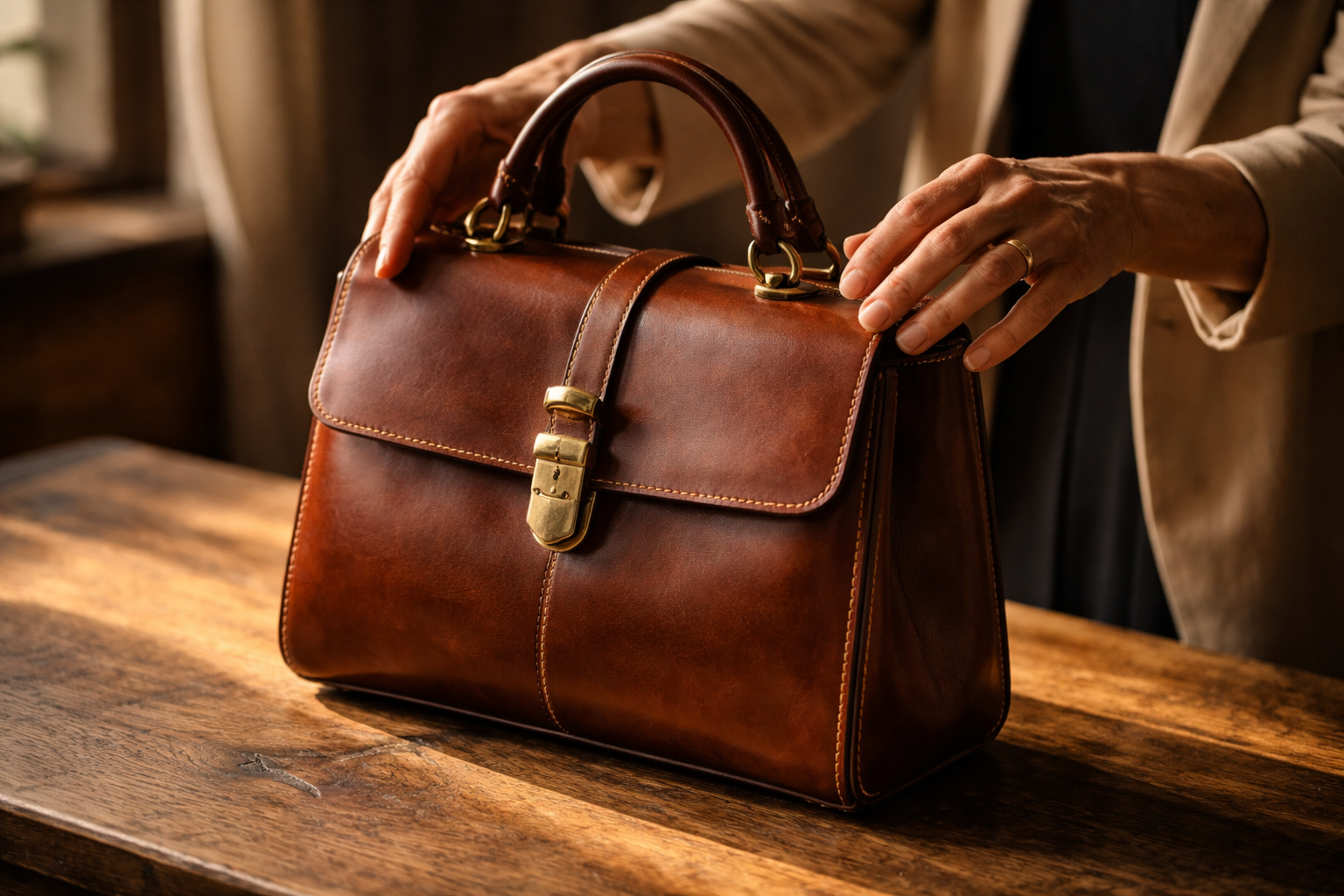
Why a Truly Handmade Leather Bag Is Unlike Anything Else You Will Ever Own
Picture yourself in one of those flagship stores — the kind where the air itself seems to have been imported from somewhere more rarefied than wherever you came from. The lighting is precisely calibrated to make everything look magnificent, including you. A bag sits on a plinth in front of you. It is beautiful in the way that very expensive things are often beautiful: confidently, without apology, as though beauty were simply its natural state rather than the result of an enormous marketing budget. The bag is not handmade. You will find that out later.”

The price tag is extraordinary. Not impossible — you’re not here by accident — but extraordinary. You pick it up. You turn it over. You run your fingers along the seam. And here’s the thing: something doesn’t quite land. The bag is beautiful. You know it’s beautiful. And yet there’s a faint hollowness to the transaction, like listening to a recording of a symphony rather than the symphony itself. You can’t name it, so you buy the bag anyway. You’ve spent enough years trusting your own taste that a moment of inexplicable doubt isn’t going to stop you.
Six months later, you understand what was missing.
There was no one home.
Let me tell you something about machines. Back in 1811, in the wool-working towns of England’s West Riding, a group of craftsmen called the Luddites picked up sledgehammers and went after the new textile machinery being installed in the factories around them. History has not been kind to their reputation — “Luddite” has become shorthand for someone who is, essentially, afraid of progress and probably can’t work the television remote. But here’s what the history books quietly leave out: the machines those weavers were smashing were not introduced to improve the quality of the cloth. They weren’t introduced to make the craftsmen’s lives easier or to shorten the working day. They were introduced, quite deliberately, to strip skilled craftspeople of their income and, crucially, their control over the quality of what they made.
I think about this more than is probably healthy for someone who spends his days working with leather.
The logic that drove those 19th-century factory owners is precisely the logic governing the luxury goods industry today, and it has been running so long that we’ve completely stopped noticing it. The great leather houses of Europe — the ones with the waiting lists and the brand history books and the flagship stores with calibrated lighting — most of them make their bags in factories. They may be very nice factories. The workers may be well-trained. But a production line is, by definition, optimized for volume and consistency rather than for the kind of prolonged, judgment-laden attention that produces genuine quality in a handmade leather bag for women.
What does genuine quality actually require? It requires that someone slow down. It requires that someone make a thousand small decisions — about this particular piece of leather, this particular seam, this particular silhouette — that cannot be pre-programmed or replicated at scale. It requires a pair of hands attached to a brain that has a stake in the outcome.
A factory cannot give you that. What it can give you, with impressive efficiency, is a very convincing imitation of it.
While we’re being honest with each other: the word “handmade” has been so thoroughly colonized by marketing departments that it has almost lost its meaning. Most brands that use it mean “assembled by hand” — that is, machine-cut components, machine-stitched seams, finished by a worker on a production line who adds the hardware at the end. This is not, in any meaningful sense, a handmade leather bag for women who expect the real thing. It is a factory product with a handmade finishing pass, which is rather like calling a birthday cake “homemade” because you stuck the candles through the frosting yourself.
A sole-artisan bag is something else entirely. One person. One set of hands. From hide selection through pattern cutting, construction, edge finishing, and hardware installation, to the final inspection — which is really just me holding the bag up and staring at it for an unreasonable amount of time, looking for reasons to be unhappy with myself. The distinction is not merely semantic. It changes the fundamental nature of the object.
I make 100% handmade leather bags for women. I mention this with the directness I do because I want you to understand specifically what that means before we go any further.
It starts with the hide. I source leather from tanneries that still do things the slow way: Badalassi Carlo in Tuscany, whose Buttero and Wax Pull Up leathers are vegetable-tanned over weeks rather than the hours it takes to chrome-tan a hide; La Perla Azzurra, whose Dakota has a character I’ve come to know well after years of working with it; Rocky Mountain Leather, whose curated selection gives me access to hides that most manufacturers have never considered. Before I cut a single pattern piece, I spend time with the leather. I’m looking at the grain, feeling the pull of the fiber, bending it to understand how it will behave around a gusset curve or a strap junction. I’m smelling it — and yes, I know how that sounds, but a quality vegetable-tanned leather hide has a density of character that a second-rate one simply doesn’t, and you can detect it before you do anything else.
I once rejected an entire side of beautiful-looking leather because something felt wrong under the skiving knife. Turned out the tannery had rushed the drying process. The hide would have failed within two years. It cost me about three hours of work and a not-insignificant amount of money to find that out. I made the right call. I’d make it again. This is what “quality control” actually looks like when there’s only one person doing it and that person has to live with the consequences.
Pattern placement on a hide is, in its quiet way, a form of spatial intelligence: reading the topography of an animal’s skin and placing your template to take advantage of the tightest, most consistent grain while working around natural markings and structural variations. A cutting machine cannot do this. It presses a die into leather and produces the same shape, every time, regardless of what’s underneath. I cut freehand with a plethora of different knives — which is either traditional or anachronistic depending on your disposition, and probably both.
This is where I tend to lose people in conversation but win them over in person. I use the saddle stitch: two needles, one thread, each individual stitch locked independently of its neighbors. This is structurally different from machine stitching in a way that matters enormously over time. A machine stitch is essentially a chain — if the thread breaks anywhere along a seam, the whole thing can unravel in both directions. A saddle stitch is more like a series of individual knots; if one fails (and properly done, it won’t), its neighbors hold. The seam on a quality hand-stitched leather bag — any truly handmade leather bag for women — will outlast the bag itself.
I stitch at 4–5 stitches per inch on heavier structural leather, tighter on finer surfaces — a decision made for each bag, not set in software. The thread is linen, waxed, calibrated to the leather weight. Or premium bonded nylon. These are engineering decisions that happen to produce a beautiful result, which is the best kind.
Edge finishing is where you can tell, quickly and definitively, whether a luxury handmade leather handbag was made or merely assembled. I burnish my edges through multiple passes until the leather fuses into a smooth, sealed surface that grows darker and richer with years of use. A painted edge on chrome-tanned leather is not a shortcut — it is the correct finishing method for those leathers, which resist burnishing by their nature. My chrome-tanned bags get painted edges, and done properly, with quality paint built up in multiple thin coats and heat-set between passes, they are durable, clean, and entirely appropriate to the material. What distinguishes a quality painted edge from a production-line one is the number of passes, the preparation of the substrate, and whether anyone was paying attention. The same is true of burnishing on vegetable-tanned leather. In both cases, the method is secondary to the care brought to it. The hardware is solid brass or steel, sourced from suppliers I know. Zinc alloy plating is the economics of factory production making decisions about your bag’s longevity. I don’t use them, and I won’t.
She is not who you might assume. She isn’t necessarily pursuing status — or if she ever was, she’s moved through that and out the other side. She has carried the name-brand bags. She has looked at handmade leather bags for women and wondered whether the difference is real. She knows what they are. She found herself, at some point, standing in a room full of women carrying the same “exclusive” bag, which raises an interesting philosophical question about what exclusivity actually means when a factory produces several thousand units per month and calls it a limited collection.
What she’s looking for now is different. She wants provenance, not prestige. She wants to know where something came from and how it was made and who made it — because those things turn out to matter enormously to the long-term satisfaction of owning an object. She has a constitutional allergy to disposability, in objects as in relationships, and she has noticed, with some irritation, that the luxury market has spent the last two decades selling her very expensive disposability while calling it quality.
She thinks about longevity. Not as an abstraction, but as an actual calculation: what does it cost per year to own a leather bag that lasts a lifetime versus one that deteriorates in three? [The math, once you do it, is clarifying. And a little embarrassing, given what one has previously spent.] She keeps things. She has her grandmother’s watch. She has opinions about restoration.
She also — and this is the part the big brands have entirely failed to understand — wants to know who made it. Not in the vague sense of “Italian artisans” photographed looking noble for the brand’s autumn campaign, but actually: what is this person’s name, what are their specific skills, what decisions did they make while making this particular bag, and can she ask them a question and get a straight answer? The accountability that comes with a sole artisan — where the person who takes your money is the same person who made your bag and who will stand behind it — is a fundamentally different relationship than the one you have with a corporation whose customer service department is a phone tree.
One-of-a-kind people deserve one-of-a-kind bags. I didn’t come up with that line to be clever. It is the logical conclusion of everything I’ve just described.
I am what I am partly because of my grandfather’s battered alpine rucksack and partly because of a stubborn conviction — shared, as it turns out, with those maligned Luddite craftsmen — that real work deserves real attention. Those weavers, who have been so thoroughly misrepresented by history, were not ignorant men afraid of the future. Some of them were studying ancient Greek in their workshops, appointing a reader to educate the community while their hands were occupied. The historian Peter Linebaugh, in a fascinating account of the period, makes the point that what those early industrial machines destroyed was not just income but the craftsperson’s control over the quality of what they made — and that craft and intellectual seriousness have always, in the real tradition of artisanal work, coexisted.
I think about that a lot. The depth of knowledge that goes into understanding how a hide was tanned — what the chemistry of vegetable tanning does to the fiber structure over weeks of immersion in oak bark or mimosa extract, how that differs from chrome tanning, how those differences change every construction decision I make — is not separate from the quality of the finished bag. It is the quality of the finished bag, showing up in choices the customer will feel for years without being able to name.
I correspond with a Japanese master leatherworker whose grasp of structural technique makes most Western bag-making look approximate. I study how a French seam behaves differently from a butt seam under lateral stress. I research the historical construction methods of the bags I’m trying to update — the structured handles of my grandmother’s era, the way gusset geometry changed in the postwar decades and why. This is not background decoration. It goes into the work.
Being a sole artisan also means the output is physically limited. I can produce only a limited number of bags per year, because the level of attention my process requires is necessarily time-consuming. This is not a scarcity strategy. It is a natural consequence of doing the work properly. What it means for you is that there is an inherent exclusivity of quality here that cannot be manufactured at scale — and, more importantly, that you are not competing with a warehouse. You are commissioning a craftsperson’s attention.
Nerina Leatherworks operates as a Private Membership Atelier, which I should explain, because “private membership” sounds like it involves a secret handshake and a waiting list managed by someone with a clipboard. It is considerably more straightforward than that.
Membership is free, by invitation. What it creates is a relationship rather than a transaction. You’re not buying from a shop; you’re commissioning from a craftsperson who knows your name, remembers what you ordered, and can have a genuine conversation with you about what you want next. The custom leather bag process — where you bring your preferences to one of the existing designs, or we develop something more specifically suited to your life and how you move through it — is only possible at this scale. When the person you’re talking to is the person who will actually execute the work, the conversation is different. Better. More honest.
I also offer a buy-back and resell service, which I include not as a commercial proposition but as a statement of confidence. I am willing to buy back what I made because I know what it is. A bag that holds its value after years of actual use is a bag that was worth buying in the first place. A bag you can resell through the same atelier that made it — that is not a depreciating asset. That is an heirloom with a secondary market.
You are standing in the flagship store again. The bag is on its plinth. The lighting is doing its best work. And now you know, precisely, what is missing.
It isn’t the craftsmanship, exactly — the seams are probably fine. It’s the story. Or rather, its absence. There is no one behind this object — no particular intelligence that chose this hide over another one, no specific hands that adjusted the stitch tension on the third pass, no person who held the finished bag under a light and felt something about it. It came from a process. An efficient, well-managed, thoroughly optimized process — but a process nonetheless, and processes don’t care about you.
A handmade leather bag for women, made by one person’s hands — 100% handmade, from a quality hide chosen for its particular character, constructed with techniques designed to outlast the maker, finished to a standard the maker would be embarrassed to fall short of — holds something that cannot be manufactured at scale. It holds the attention and the judgment of the person who made it. That is not a romantic notion. It is the literal, structural consequence of how the object was built, stitch by individual stitch, pass by pass, decision by decision.
The right woman doesn’t need to be persuaded of this. She’s been thinking something very much like it for years, and growing quietly impatient with the industry’s failure to take it seriously. She’s simply been waiting for a bag that proved her right.
That’s what a handmade leather bag for women should be. It’s the bag I make.
Nerina Leatherworks · nerinaleatherworks.com · Colorado, USA