
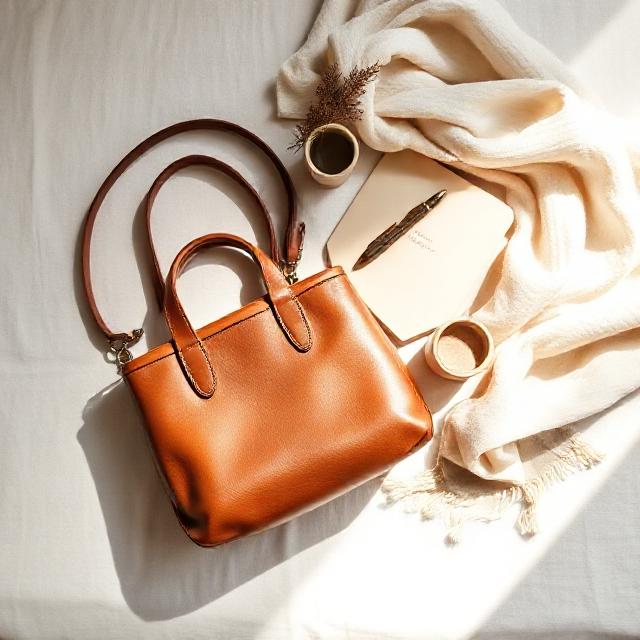
Late one afternoon over a Zoom call, a client asked me something I’ll never forget. She was holding two bags I’d just completed—both the same design, both made from premium full-grain leather. Yet as she ran her hands over each one, her expression shifted from curiosity to confusion.
“Why do these feel so completely different?” she asked. “This one”—she gestured to the Toccata bucket bag—“feels substantial, almost architectural. But this one”—the Rhapsody handbag—“it’s supple, like I can squish it in my hands. They’re both beautiful, but they’re not the same at all.”
She was right, of course. And her question gets to the heart of something I wish more women understood before commissioning a luxury handmade leather bag: material selection isn’t just about “good leather.” It’s about understanding how leather type, tanning method, surface finish, and every complementary material work together to create something that moves through the world exactly as she does.
Those two bags she held? The bucket bag was made of full-grain Buttero vegetable-tanned leather from Tuscany—it would develop a rich patina, showing the story of her life in subtle color shifts and a distinctive sheen where her hands touched it most. The other was handcrafted from Alran Samoa large grain chèvre leather, sourced from France—it would stay true to its original color, resist water and stains, and maintain its adorable appearance without visible aging.
Neither choice was better. They simply offered a different relationship with time and use. And that’s what I want to explore with you here—not what you should choose, but how to understand your options deeply enough that your choices become instinctive, personal, and ultimately, deeply satisfying.
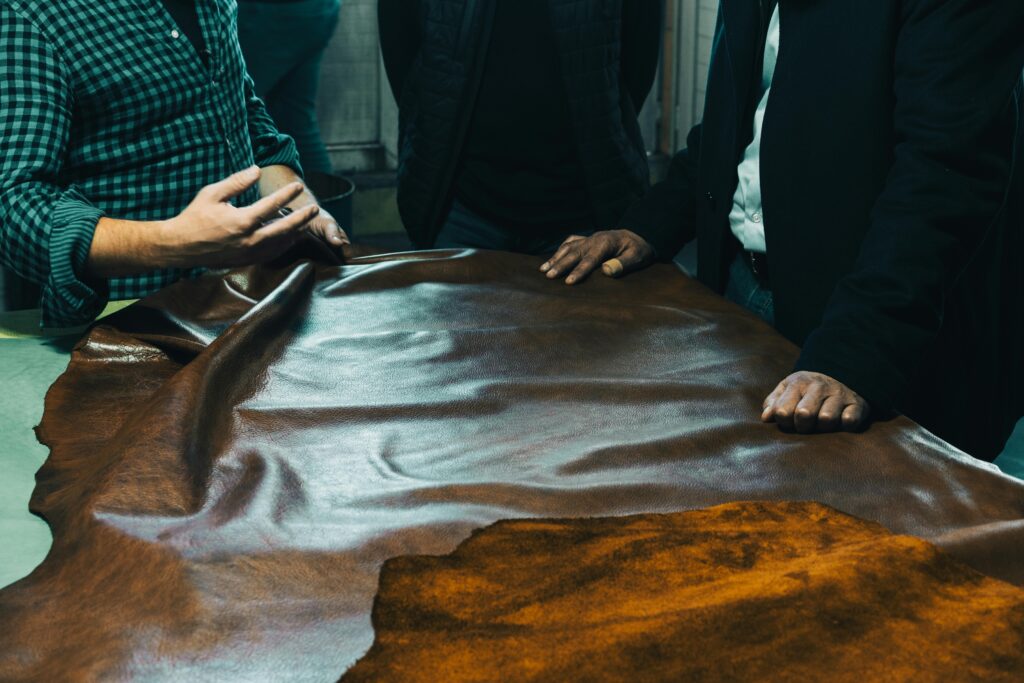
Look, I can show you photographs all day long. Beautiful lighting, perfect angles, that rich leather texture jumping off your screen. But photographs lie—or at least, they can’t tell you the whole truth.
What they can’t show you is hand.
When I talk about a leather’s hand, I’m talking about something you’ll feel every single time you reach for your bag. It’s how the leather behaves in your actual hands—does it hold its shape with architectural precision, or does it soften into elegant folds when you set it down? What’s the weight? How does it respond when you grip the handles? Is there a subtle give as you close the clasp, or does it snap shut with authority?
Here’s what most women don’t realize when they’re shopping online or even looking at samples: that hand is determined long before I ever cut into the hide. Hell, it’s decided before the hide even arrives at my studio. It happens in the tannery, in decisions about how to transform raw animal skin into something beautiful and lasting.
And those decisions? They’re not just technical. They’re philosophical.
If you’re searching for “vegetable-tanned Italian leather bag vs chrome,” you’ve already sensed that this distinction matters. Let me tell you why, from someone who works with both every single day.
Vegetable tanning is the ancient method—we’re talking techniques that haven’t fundamentally changed since before your great-grandmother was born. The hide spends weeks, sometimes months, in vats containing tannins extracted from tree bark, leaves, plant materials. It’s slow as hell. It’s expensive. And it produces leather with a firm, almost waxy feel when it’s new.
I remember the first time I worked with Buttero from Conceria Walpier in Tuscany. Opened the roll and just stood there like an idiot, running my hands over it. That’s the thing about truly great vegetable-tanned leather—it announces itself.
But here’s what makes it remarkable, what keeps me coming back to it even when chrome-tanned would be easier and more profitable: vegetable-tanned leather is alive in a way that chrome-tanned isn’t. It breathes. It absorbs the oils from your hands, the moisture from the air, the accumulated patina of daily life. A vegetable-tanned bag made with aniline-finished leather develops character that’s genuinely unique to its owner—darkening where she grips the handles, developing a soft burnished glow across the body, showing subtle color variations that tell the story of everywhere she’s taken it.
I’ve seen bags I made fifteen years ago come back to me for minor repairs, and I swear to you—they look better now than the day they left my studio. That’s not nostalgia talking. That’s the magic of vegetable-tanned leather that ages well. It improves, like a fine leather jacket that becomes more you the longer you own it.
The trade-off? Yeah, it’s more sensitive initially. Water can leave spots (though they fade as it dries). It needs a break-in period—don’t expect butter-soft on day one. And you need to understand, really understand, that the bag you receive will look different in a year. Richer, deeper, more complex. Some women hear that and their eyes light up. Others? I can see them mentally backing away.
Both reactions are valid. This is about knowing yourself.
Chrome tanning, by contrast, is the modern efficiency expert. The hide gets treated with chromium salts in a process that takes about a day—not weeks, a day. The result is leather that’s soft from the moment you touch it, lighter in weight, and far more resistant to water and staining.
Now, let me address something that drives me slightly crazy. I keep reading articles—clearly not written by people who actually work with leather—claiming chrome-tanned leather has this awful “chemical smell.” Working with premium chrome-tanned hides from reputable tanneries, which is all I’ll touch, I’ve never encountered this. That’s a quality issue with cheap leather, not an inherent characteristic of the chrome-tanning process itself. It’s like judging all wine by what comes in a box.
What chrome tanning gives you is color stability. Commiss ion a bag in a specific shade of forest green or burgundy? It stays that exact color. It won’t fade. It won’t darken. It won’t develop patina in the traditional sense. For many of my clients—especially those who’ve searched “luxury leather bag that maintains original color”—this consistency is precisely the point. A bag that looks impeccable on day one and maintains that same polished appearance for decades.
And I need to correct another misconception I see constantly: chrome-tanned bags aren’t inevitably slouchy. Yes, the leather tends to be softer and more pliable. But listen—with proper reinforcements, stiffeners, and structural support (which I build into every single bag I make), a chrome-tanned bag can hold its shape beautifully. In my collection, you’ll find both: structured chrome-tanned designs that could double as small briefcases, and softer vegetable-tanned styles that drape like fabric. The tanning method is just one variable in a much more complex equation.
The real question isn’t which is “better.” The question is: what kind of relationship do you want with your bag over time?
Once leather leaves the tannery, how it’s finished determines everything about how it looks, feels, and performs in your daily life. This is where I see the most confusion among clients—especially those searching “handmade luxury leather bags with natural finish” or “scratch-resistant leather handbag options.”
The confusion is understandable. The terminology sounds technical. And honestly? A lot of makers don’t bother explaining it because it’s easier to just say “premium leather” and move on.
I don’t work that way. You’re investing serious money. You deserve to understand exactly what you’re getting.
Full aniline leather is dyed with transparent dyes that let you see straight through to the hide’s natural grain. Only the finest hides qualify for this treatment—any imperfection shows, so if there’s a scratch or mark, that hide gets rejected for aniline finishing.
What you get is leather in its most honest form. You’ll see natural markings. Slight variations in texture. The gorgeous irregularity that proves this came from an actual animal, not some factory simulation. Touch it and you feel every nuance—the grain, the slight temperature difference from the surrounding air, the way it yields just slightly under pressure.
Set it in sunlight and watch how the dye creates depth, like you’re looking through stained glass. It’s remarkable, really.
But understand what you’re signing up for: aniline leather on a vegetable-tanned hide will mark. Water darkens it temporarily. Your hands will leave oils that deepen the color over time. Scratches show (though on vegetable-tanned leather, they can often be gently buffed away or massaged back with warmth and pressure—I’ve done it myself on bags that come back to me).
This is the choice for the woman who wants a bag that becomes uniquely hers—not through monogramming or some added personalization, but through the accumulated evidence of her life. When I complete an aniline-finished vegetable-tanned bag, I tell clients straight up: “This bag will age with you. In five years, no one else will have one exactly like it. Including you, if you commissioned another one tomorrow.”
Some women hear that and practically vibrate with excitement. Others look vaguely horrified. Neither reaction is wrong.
Semi-aniline adds a light pigmented protective layer over the aniline dyes. You still see the leather’s natural character, but there’s a buffer between the hide and the world.
This is my recommendation for clients who love the aesthetic of aniline but need something more forgiving. The woman who travels constantly for work. The one who wants to set her bag down in a restaurant without worry. She still gets beauty, still gets quality—just with a bit more armor.
Fully pigmented leather is sprayed with a colored coating that seals the surface. This is the most durable, most stain-resistant, most weather-proof option I offer.
Now, some leather purists—and I know plenty of them—will turn up their noses at pigmented leather. They’ll tell you it’s not “real” leather or it’s somehow lesser.
That’s bullshit.
A woman who wants her bag to look exactly the same in year ten as it did on delivery day? That’s not a lesser choice. That’s clarity about what she values. Pigmented leather gives her consistency, reliability, and freedom from anxiety. She can set that bag down in a restaurant without doing a mental check of the table surface. She can toss it in the passenger seat of her car. She can use it like the tool it’s meant to be, not treat it like some precious museum piece.
The pigment also opens up a world of color options. Want a bag in a specific shade that matches your brand colors exactly? Need a tone that doesn’t exist in nature—that particular shade of coral or that specific dusty rose? Pigmented leather makes it possible. Chrome-tanned pigmented leather, especially, takes color beautifully and holds it forever.
Now we get to smooth versus pebbled—a distinction that affects both aesthetics and practical performance.
Smooth leather showcases everything. Light reflects off it uniformly, creating that polished elegance you see on classic bags. The leather’s grain pattern shows clearly. It holds structure beautifully over time because it tends to be firmer.
But scratches show. Scuffs are visible. This is formal luxury that asks for care.
Pebbled leather is embossed with a raised texture—literally pressed under extreme heat and pressure to create that characteristic bumpy surface. And here’s what makes it brilliant for daily-use bags: that texture hides wear like nothing else.
The way light scatters across all those tiny peaks and valleys means scratches virtually disappear. I’ve had clients come back after a year of what they describe as “brutal” use—thrown in overhead bins, shoved under airplane seats, dropped on concrete—and the bag looks maybe a month old. Laboratory testing shows pebbled leather withstands significantly more abrasion than smooth.
In practical terms? A pebbled bag is nearly indestructible for daily use. I recommend it constantly to clients who travel for work, who are honest about being hard on their belongings, who want luxury without that low-level anxiety of “am I damaging this?”
The texture also creates visual interest. Where smooth leather is refined and quiet—very “notice my elegance”—pebbled leather has personality. It’s a more casual elegance that works as well with jeans as with a suit. Some of my clients who commission smooth leather bags for professional use will then commission pebbled versions for weekends. Different tools for different contexts.
A bag is never just its exterior leather. What’s inside, what reinforces stress points, what secures closures—these hidden materials determine whether your bag lasts five years or fifty.
I learned early in my career—painfully early, through a few disasters I’d rather not detail—that clients notice the lining before almost anything else. It’s the first thing they see when they open their new bag. It’s what touches their belongings. It tells them, immediately and viscerally, whether they’ve invested in quality or just spent money on appearance.
Get the lining wrong, and it doesn’t matter how spectacular the exterior leather is. The bag feels cheap.
Leather linings are my preference for heirloom-quality bags. Not pig skin, which some artisans use but which I find frankly too coarse for luxury work. Instead, I use pig suede—lightweight, with a subtle nap that feels luxurious and protects contents from shifting. Or chevre (goat leather), which is extraordinarily durable despite its thinness. It’s naturally soft, wipes clean effortlessly, and ages beautifully. For the ultimate interior luxury, lambskin—butter-smooth, opulent, the same material used inside the finest couture garments.
Yes, leather linings add weight. Yes, they add cost. But they also ensure that in twenty years, when half your closet has been donated or fallen apart, the inside of your bag will look and feel nearly as perfect as it did new. I have bags from the late 1990s with leather linings that are still immaculate. The exterior has developed patina, but inside? Pristine.
For clients who prefer textile linings—or whose bag designs work better with lighter-weight interiors—I have several premium options that deliver luxury without the weight penalty.
High-grade cotton twill is my workhorse textile lining. I’m talking about tightly-woven, substantial twill in Egyptian or Pima cotton varieties—the same quality you’d find in premium shirting. Cotton twill provides genuine durability for bags that endure daily use, handles abrasion from items being moved in and out, and maintains its structure over years of service.
Silk remains the traditional choice for evening bags and special occasion pieces. Houses like Hermès, Chanel, and Louis Vuitton use silk linings in their special edition bags precisely because silk conveys unmistakable luxury. The softness and luminous sheen create an aura of elegance, and silk naturally manages moisture while remaining breathable. But I’m honest with clients: silk is delicate. It snags. It stains. For a bag that’s going to live a real life—being tossed in the car, crammed under airplane seats, actually used—silk might be aspirational but impractical.
For bags that need to feel special but work hard, I often recommend grosgrain for accent details. Leading luxury brands like Hermès, Gucci, and Louis Vuitton use grosgrain for interior ribbons, pocket bindings, and structural accents.
The critical distinction in textile linings isn’t just the fiber—it’s the weight and weave density. Lightweight fabrics lack body and show every wrinkle and stress point. Overly heavy fabrics add unnecessary weight and create bulk at seams.
Here’s where craft separates from mere construction. This is the stuff nobody sees, nobody photographs, nobody talks about in marketing copy. But it’s what determines whether your bag lasts five years or fifty. To be honest, this is what gets me going!
At every stress point—where hardware attaches, where handles connect to the body, where pockets meet seams—I add reinforcement that you’ll never see but will absolutely feel in how the bag performs over decades of use.
I use corazza, a non-stretch reinforcement material, similar to interfacing but specifically engineered for leather goods. Or velodon, another specialized reinforcement material. Or microfibra, a premium reinforcement from Luigi Carnevali in Italy—they’ve been making this stuff since 1908, and luxury brands have been using it ever since because nothing else performs quite as well.
These materials prevent the leather from tearing at attachment points, stop straps from stretching over time (because stretched straps look sloppy, and more importantly, they’re uncomfortable), and ensure that hardware stays secure. They’re hidden patches applied to the wrong side of the leather, completely invisible in the finished bag.
I also use additional stitching at these stress points—not just a single pass, but reinforced points that distribute force across a specific area. It takes extra time. It’s harder to do without it looking bunched up. But it ensures your bag doesn’t fail at the most critical junctures, right where you need it to hold together.
You’ll never notice this work. But twenty years from now, when the handles are still firmly attached and the hardware hasn’t torn through? You’ll feel it.
For clients searching “exclusive bags made in USA by artisans” or “custom exotic leather handbag,” the question often arises: full exotic construction, or exotic as accent?
Python, crocodile, ostrich—these materials are undeniably luxurious. Full exotic bags make statements. They’re investments. They’re evening pieces or signature styles that announce themselves when you walk into a room.
But here’s what I’ve learned from my meager experience: strategic exotic accents often create more versatile, more wearable luxury.
Python handles on a smooth leather tote? Stunning. You get that unmistakable exotic luxury right where your hands are, where you’ll see it and touch it constantly. Ostrich panel insets on a shoulder bag? Creates gorgeous textural contrast without overwhelming the design. Crocodile corner reinforcements? They add both beauty and genuine protection—those corners take abuse, and the crocodile can handle it.
This approach gives you uniqueness without the weight (exotic hides, especially crocodile, can be heavy), luxury without the full exotic price point, and versatility. A bag you can carry to the office and to dinner without it feeling like too much in either context.
The key is thoughtful placement. Exotic accents shouldn’t look like you couldn’t afford the full version. They should look intentional, artistic, like the design always called for exactly that contrast of textures.
When I do use full exotics—and I do, for clients who want that—I make sure they understand what they’re getting. The weight. The care requirements. The reality that this is a special-occasion bag, not an everyday workhorse. Some women want exactly that. They want the full crocodile Capriccio Baguette Bag because they’re making a very specific statement in very specific rooms.
Perfect. I’ll make it for them. But I’ll also make sure they know what they’re signing up for.
Here’s what I’ve learned about how to think through your own material selection:
If you want a bag that develops visible character over time—choose vegetable-tanned leather with an aniline or semi-aniline finish. Understand that it will change, and decide whether those changes sound like improvements or damage to you. If “patina” sounds romantic, this is your path. If it sounds like wear, choose differently.
If you want your bag to stay exactly as it is—choose chrome-tanned leather with semi-aniline or pigmented finish. You’ll maintain the aesthetic you fell in love with, without surprise color shifts or darkening. This is not a lesser choice; you’re just being clear about what matters to you.
If you’re hard on your belongings—pebbled chrome-tanned leather with semi-aniline finish. Nearly indestructible, hides wear, lightweight, and still undeniably luxurious.
If you want formal polish—smooth vegetable-tanned leather with semi-aniline finish. It holds structure beautifully, develops subtle patina without dramatic change, and works in professional contexts for decades.
If you value environmental consciousness—vegetable-tanned leather (natural tanning process), organic cotton twill or linen lining (biodegradable, renewable natural fibers), and premium hardware that lasts lifetimes rather than breaking and ending up in landfills. Longevity is the ultimate sustainability.
When you want to customize a bag from Nerina Leatherworks, we don’t begin with hardware choices or pocket configurations. Hell, we don’t even start with the design itself.
We begin here—with materials. With understanding what you want your bag to feel like in your hands, how you want it to age (or not age), what kind of relationship you want to have with this object you’ll carry almost every single day for potentially decades.
Because these decisions—vegetable versus chrome, aniline versus pigmented, smooth versus pebbled, leather versus textile lining—these aren’t technical specifications on a form. They’re choices about how you move through the world, what you value, and what kind of luxury actually speaks to you personally.
That client who held those two different bags on our Zoom call? She loved both. The Buttero vegetable-tanned aniline bag became her weekend companion, the one she takes to galleries and dinners, the one she loves watching develop character. The Alran chèvre became her garden party bag—its silhouette whispering restraint, the corset-inspired clochure suggesting hidden complexity. This balance of innocence and sensuality makes her bag more than an accessory—it becomes a statement of character.
She understood something important: the “right” choice isn’t universal. It’s not even consistent within your own life. It’s personal. It’s contextual. It’s about matching material to purpose, aesthetic to values, leather characteristics to lifestyle.
And that understanding—that’s what transforms a bag from an expensive purchase into something that becomes genuinely, irreplaceably yours.
Look, I could make this simpler. I could just say “premium full-grain leather” on my website and call it a day. Most makers do. It would certainly make the sales process faster.
But you’re not looking for fast. You’re looking for right. You’re searching “handmade leather bag that ages well” or “luxury Italian leather tote” because you understand that details matter, that materials matter, that the choices you make now determine whether this bag becomes something you treasure or something that ends up in the back of your closet.
I respect that. It’s why I do this work.
And it’s why every bag that leaves my studio carries not just my maker’s mark, but a specific combination of materials chosen deliberately, constructed thoughtfully, and built to last far longer than either of us will probably be around.
That’s not marketing. That’s just how I work.
Ready to explore material options for a bag that reflects your aesthetic and lifestyle? Visit our custom process page to begin the conversation. Each commission starts with understanding not just what you want your bag to look like, but how you want it to live with you—and that begins with choosing materials that align with your vision.