
I was watching a documentary recently about the evolution of NFL team uniforms—decades of iteration, the missteps into gaudy excess, the over-corrections into sterile minimalism, and the gradual refinement toward designs that somehow feel both fresh and inevitable. An unlikely source of insight for someone interested in designs of luxury handmade leather handbags, perhaps. But what struck me wasn’t the color blocking or iconography. It was the underlying grammar of design refinement—the iterative process by which excess gets pared away, essential elements get emphasized, and equilibrium emerges between recognition and novelty.
The aesthetic endpoint couldn’t be more different from my work. My clients seek understated elegance, not team allegiance. But certain principles of handmade leather bag design prove universal, and I’ve found myself returning to them repeatedly as I develop new collections.
Luxury design tends to move in the opposite direction from mass-market design. Where commercial design asks “what can we add to make this more appealing,” artisan leather craftsmanship asks “what can we remove while still achieving purpose and beauty?”
This isn’t minimalism for its own sake. It’s the confidence that comes from knowing your materials and construction can carry the weight of attention without distraction. When you’re working with full-grain vegetable-tanned leather from Tuscany or French chèvre from centuries-old tanneries, the material itself commands presence. Design exists to reveal that presence, not compete with it.
In my workshop, every element must earn its place. A piece of solid brass hardware, a hand-stitched seam, a pocket placement—each either serves function, reveals material quality, or does both. The moment something exists purely for decoration, I’ve crossed into territory my clients have explicitly rejected by choosing handcrafted leather goods over logo-heavy alternatives.
This is perhaps the most delicate balance in designing timeless leather handbags. A client needs to recognize a piece as belonging to a coherent sensibility—this creates collection unity and builds identity without flashy logos. Yet she also needs to feel she’s acquiring something fresh, not simply another iteration of what she already owns.
The resolution lies in what I call signature constraints—elements that remain consistent and become associated with your work, against which variation occurs. For me, this includes a particular approach to edge finishing, consistent handle attachment philosophy, certain proportion relationships, and construction methods both visible and invisible in the final piece. These become my visual language, and new designs are sentences written in that language rather than departures from it.
A woman familiar with my work should be able to identify one of my bags across a room without seeing a label, yet still discover something new when she examines it closely.
In my positioning as a maker of luxury leather goods without prominent branding, the leather itself does most of the communicating. Design exists to honor the material, not compensate for it. This inverts the equation you see in mass-market luxury, where elaborate design often distracts from mediocre materials.
This creates an interesting constraint: forms should be chosen partly for how they display the leather’s character. A piece in Badalassi Carlo Waxy leather might call for broader uninterrupted surfaces that show the pull-up and develop beautiful patina over time, while Taurillon leather might support more complex construction that showcases its remarkable drape and suppleness. The design serves the material’s story rather than imposing a story onto generic material.
When clients ask me about custom leather handbag design, this is often where we begin—not with shape or size, but with which leather speaks to them and what forms will let it speak most eloquently.
My clientele has consciously opted out of visible luxury in favor of quality recognized only by the informed eye. This creates both permission and obligation to include details that reward close attention without announcing themselves.
The quality of a rolled handle. The precision of a corner where multiple layers resolve cleanly. The way a gusset flows into a body panel. The selection and placement of hardware—solid brass that will develop its own patina alongside the leather. The thread choice, the stitch length, the subtle differences in tension that distinguish hand-stitching from machine work.
These are details meant for the owner and the genuinely curious, not for observers across a room. This is the essence of understated luxury handbag design—confidence quiet enough to require attention rather than demand it.
A handbag is not a sculpture. It’s a working object that accompanies a woman through her day. The most enduring designs tend to be those where beauty emerges from function perfectly resolved rather than from form imposed despite function.
Handle drop that suits actual carrying posture. Interior organization that reflects how women actually live—the devices they carry, the items they need quick access to, the things that can be tucked away. Closures that secure contents without creating daily frustration. Proportions that accommodate real possessions rather than editorial styling.
These functional considerations, elegantly resolved, produce beauty more lasting than purely aesthetic decisions. This is where the bespoke relationship becomes a design advantage. Through direct conversation with clients, I understand how bags are actually used, not merely how they photograph.
Perhaps the subtlest consideration in designing premium handcrafted bags: where does a piece sit in time?
My clients want neither obviously dated nor conspicuously trendy. The goal is something that could have existed for decades and will continue to exist for decades—what I think of as permanent contemporary. A bag that looks at home in a photograph from the 1960s and will look equally at home in 2050.
This doesn’t mean ignoring the present moment entirely. Contemporary relevance might appear in proportion adjustments that suit current device sizes, closure mechanisms that accommodate modern life, or colorways that feel fresh without announcing their year of origin. The skill lies in incorporating timeliness within a frame of timelessness.
Most luxury brands treat aging as a problem to solve—coatings to prevent patina, materials chosen for their resistance to showing use. There’s a different philosophy available, but it’s not the only one worth having.
Vegetable-tanned leather records the life of its owner. Where she gripped, the handles darken. The body develops a burnished glow from contact with her hip, her desk, the passenger seat of her car. I’ve seen bags I made fifteen years ago richer, deeper, and more unmistakably hers. For the woman who wants a bag that becomes uniquely individual through use rather than through monogramming, this is the path.
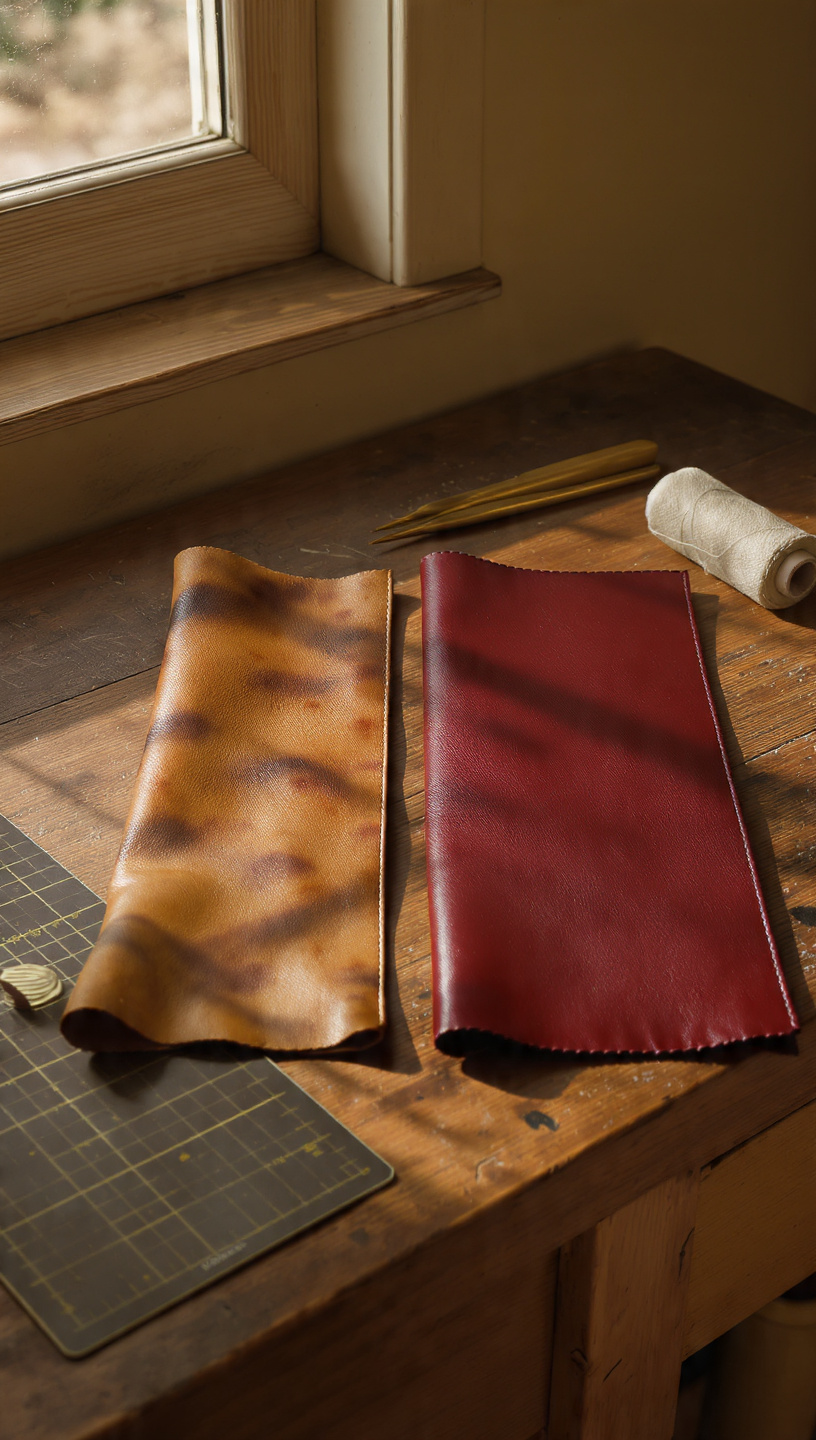
But I work with chrome-tanned leather too, and not as a compromise. Some clients know exactly what they want: that precise shade of burgundy or forest green, maintained exactly as it appeared on day one, for decades. They want a bag that looks impeccable in a boardroom whether it’s Tuesday or ten years from Tuesday. Chrome-tanned leather—soft from the first touch, stable in color, resistant to water and the minor indignities of daily life—delivers that consistency. This isn’t settling. It’s clarity about what matters to you.
The question isn’t which leather is better. It’s which relationship you want with the object you’ll carry almost every day. Do you want to watch it change and know those changes are yours alone? Or do you want the polished reliability of something that stays exactly as you chose it?
Both answers are right. The wrong answer is not knowing which one you’re giving.
The boundaries I work within—sophisticated, restrained, honoring tradition while serving contemporary life—might seem limiting. I’ve found them liberating. They eliminate vast swathes of possibility and force refinement rather than invention.
The question becomes not “what new thing can I create” but “what essential thing can I make more perfectly?” Within narrow parameters, depth becomes possible in a way that breadth never permits.
This is, I suspect, the real lesson from watching any designed object evolve over decades. The endpoint isn’t novelty. It’s the quiet resolution of competing demands—function and beauty, tradition and freshness, recognition and surprise—into something that feels, finally, inevitable.
That feeling of inevitability is what I’m reaching for with every bag that leaves my workshop.