
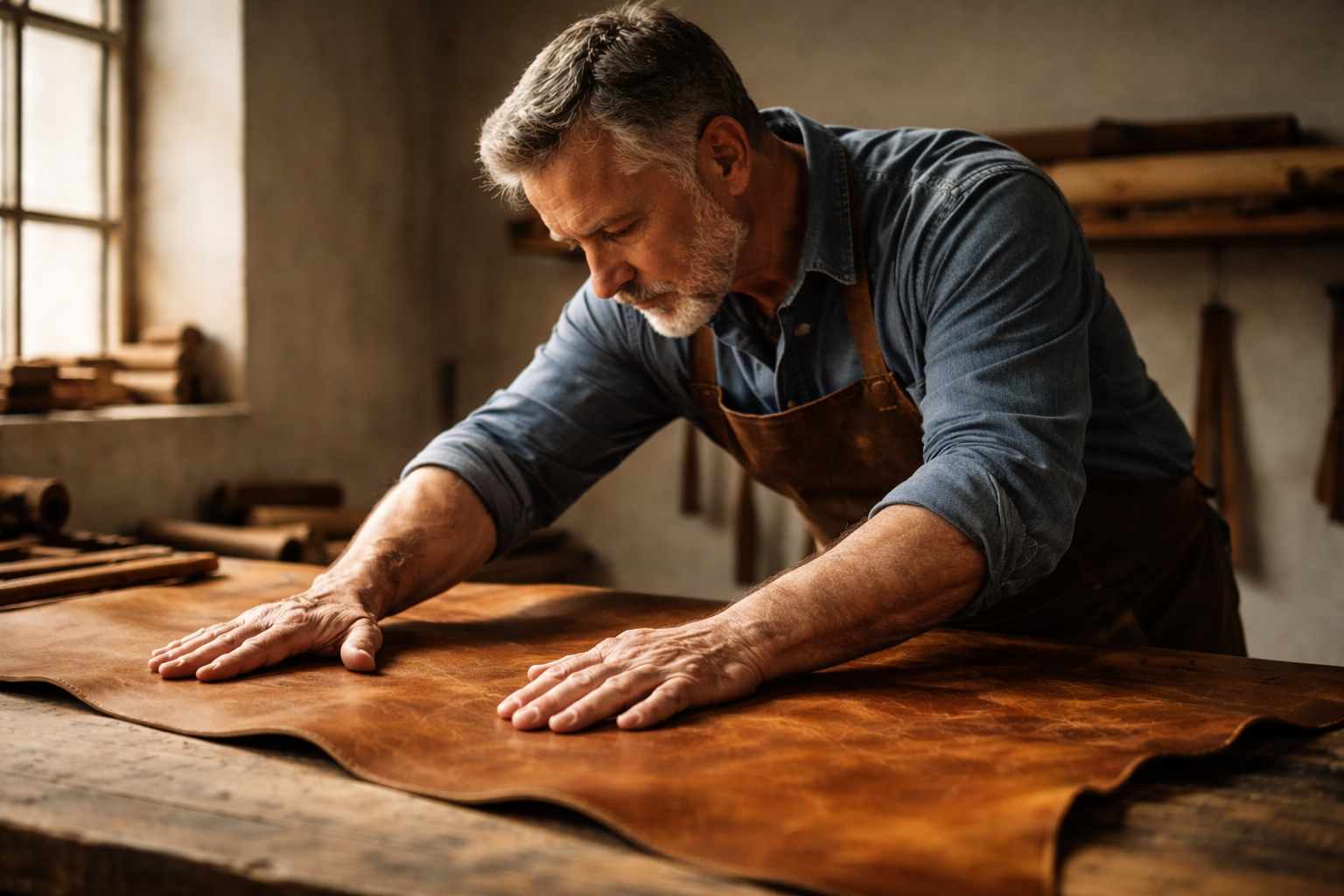
Not long ago, I found myself in a conversation with a Japanese master leather craftsman — a man who has spent more than a decade at the workbench, and whose bags carry the kind of quiet authority that makes you instinctively lower your voice in their presence. We were talking, as craftsmen do when they trust each other enough to be honest, about a bag he was building that troubled him. By any objective measure, the thing was beautiful. Technically impeccable. And yet something was wrong. “It does not breathe,” he said, in the careful English he reserves for conversations he considers important. “It does not have ease.”
I knew exactly what he meant.
And that exchange — that single, almost throwaway observation — crystallized something I have been trying to articulate for years: what separates a luxury handmade leather bag that truly lasts a lifetime from one that merely endures it.
Stay with me here, my friend, because this is where the really interesting part begins.
When most women hear the phrase “a bag that lasts,” they think structurally. They think stitching tension, leather grade, the quality of the hardware. And look — all of those things matter enormously. I spend considerable hours obsessing over them myself, agonizing over whether a particular gusset panel calls for a 0.5mm microfibre composite or a 0.7mm bonded leather stiffener, lying awake at 2 a.m. mentally revisiting a reinforcement decision. (Not, I should clarify, the kind of dinner-table conversation that earns you a great many social invitations.)
But structural durability, as important as it is, is actually the easier problem. Given time, premium materials, and a craftsman who knows what he’s doing, it mostly solves itself. What’s harder — what requires something closer to wisdom than to skill — is achieving rightness of form.
A bag with the right form doesn’t merely survive years of use. It deepens with them. It becomes more itself — and, crucially, more hers — with every passing season. That, to my mind, is what luxury handmade leather bags that last are actually made of. Not just good leather and tight saddle stitching, though God knows those matter. But a form so precisely matched to its purpose, and to the woman who carries it, that it could not have been otherwise. A form that was right from the very beginning, before a single hide was selected, before a single cut was made.
Rightness, unlike trendiness, does not expire.
And if you want to know what quality actually looks and feels like before you’ve committed to a penny — how to tell the real thing from the convincing pretender — this guide to identifying quality in a leather handbag is a useful place to start.
Back to that conversation — and to that bag.
My counterpart described a gusset that he had allowed to expand its function. Where a conventional gusset simply prevents the bag’s sides from splaying outward — you know that deflated, defeated look a cheap tote develops when you set it on a chair? — his had been redesigned to also restrain vertical movement, folding under the flap in a way that reduced what he could only describe as the “airflow” over the top edge. The bag’s contents, once enclosed, were very thoroughly enclosed. And the bag — this was his word, and I thought it was brilliant — did not breathe.
I thought immediately of a vase of flowers. A good vase has a rim that doesn’t merely support the stems; it allows them to splay outward gently, revealing the beauty of the blooms and giving them room to express themselves. A vase that grips the stems too firmly turns the whole arrangement into a fist. The beauty is technically present, but it is withheld — strained. You look at it and feel, without quite being able to say why, that something is being held back.
The gussets in my counterpart’s bag were performing something very like a hug. And a hug — as we all know, having received both the welcome and the distinctly unwelcome varieties — is an act of enclosure that is also an act of care. The question is simply whether the degree of enclosure is right for the moment, and for the person being held.
Here I reached for a musical analogy, which I offer not out of any desire to be pretentious but because it happened to be the most precise comparison available: the bag was Beethoven rather than Mozart. Not lesser — Beethoven is emphatically not lesser — but resolved. Conclusive. Its gates close. It has the quality of a final chord, a verdict delivered. It does not leave questions open at the edges. Whether this is a virtue or a limitation depends entirely on who is carrying it, and why, and what her relationship to the world happens to be on any given Tuesday morning.
Form, in other words, is not neutral. Every structural decision a craftsman makes is also a statement about what the object is for, and for whom. The bag that doesn’t breathe is not a failed bag. It is a bag that knows its own mind — that has taken a position. It will suit one woman perfectly and another not at all. Figuring out which is which is the real design work.
Here is something important about how I work, because it differs somewhat from the approach of my more architecturally adventurous peers.
I do not design luxury handmade leather bags from scratch in the sense of conjuring a silhouette from a blank sheet of paper. What I do is closer to what a skilled tailor does: I begin with proven forms — designs that have already answered the fundamental structural questions correctly — and then apply the art where the art actually belongs: in the materials, in the details, in the proportions and choices that make the bag yours rather than anyone else’s.
This is, I would argue, actually more demanding than designing from nothing, because it requires me to understand each design deeply enough to know where it can be altered without compromising its essential character — and where it simply cannot. The Toccata bucket bag, for instance, has a particular architectural quality that lives in its base geometry. Change the base dimensions significantly, and you have a different bag. You might have a perfectly good different bag, but you no longer have a Toccata. The art lies in knowing the difference — and in helping you navigate toward what you actually want, rather than what you think you want in the first flush of enthusiasm.
If you’re curious how that conversation works in practice — how “I love this style, but I’d want it in cognac with brass hardware and a longer strap” becomes a finished bag that is unmistakably yours — the custom process page walks you through it step by step. The short version, drawn from the page itself: find the design that speaks to you, and then let it sit for a little while. Your own mind, given time and space, will begin to suggest the refinements. It nearly always does.
The question of whether a bag has “the right form” cannot be answered in the abstract. It can only be answered in relation to a specific woman — with specific circumstances, a specific life, and a specific sense of what she wants an object to do for her and say about her.
This is, if I’m honest, where most of my design energy actually goes. Not the technical decisions, which become second nature after enough years at the bench, but the human ones. What does she carry? How does she carry it? Is she the kind of woman who reaches into her bag with both hands, or the kind who can locate her keys by feel alone within three seconds flat without breaking eye contact? (I have made bags for both. They need different designs.) Does she want the bag to make an announcement on her behalf before she enters the room, or does she prefer it to remain her private pleasure — something beautiful that belongs to her alone, not performed for an audience?
These are not trivial questions. They are, in fact, the design questions — the ones from which every structural and material decision flows. A luxury handmade leather bag that lasts a lifetime has to be right for the life that is actually lived in it. Not the life imagined during the ordering conversation — the aspirational, idealized version of one’s Tuesdays — but the messy, magnificent, entirely ordinary Tuesday that actually arrives.
The customization conversation I have with each client is, at its core, a design conversation in the philosophical sense. We are not merely choosing colors and hardware. We are defining what the bag is for, and for whom — which determines everything that follows. Chrome-tanned or vegetable-tanned? Structured base or a softer, more relaxed silhouette? A magnetic closure — conclusive, definite, Beethovenian — or the more open-ended suggestion of a simple turnlock? Each choice is a position taken on how she intends to move through the world. (If you’d like to understand the full weight of that choice before committing to it, I’ve written at length about how material choices shape the character of your bag — it’s worth reading.)
That conversation starts here, if you’re ready to have it.
I should say something about what actually distinguishes a handmade luxury leather bag from what the broader market offers, because the distinction is frequently misunderstood — and because it matters directly to the question of lasting.
Mass production is, in its own terms, a genuine marvel of efficiency. The machines that cut and stitch the bags you find in the boutiques of large fashion houses can produce a consistent product at a scale and speed I cannot remotely match. What they cannot do is think. They cannot look at a section of hide and notice that this particular area has a slight variation in temper — the subtle softness where the belly was, or the firmer hand closer to the spine — that means it will behave differently under tension and therefore belongs in a different panel. Nor can they decide, mid-construction, that the gusset needs to come in a smidge because the leather the client chose runs fractionally thicker than the standard. They cannot hear what the bag is asking to be.
I can. This is not boasting; it is a description of what a single craftsman working from start to finish on a single object is able to do that an assembly line, by its essential nature, cannot. Every luxury handmade leather bag I make passes through my hands at every stage: from the selection of the hide — where I am, honestly, rather ruthless in my rejections, because the leather has to be right before a single cut is made — through to the edge finishing. On chrome-tanned leathers, that means painted edges rather than burnished ones. Painted edges, I should note for anyone who has filed “hand-burnished edges” under markers of quality: for chrome-tanned leather, paint is the correct finishing method, not the inferior one. The leather’s natural composition means burnishing simply doesn’t behave the same way. Doing it right matters more than doing it the way that photographs better.
The result of this singular, attentive process is an object with integrity in the oldest sense of the word: wholeness. Every part of it knows what every other part is doing.
Let me return, finally, to that Japanese master craftsman and his unbreathing bag — because the story has a resolution, and the resolution is the point.
After we talked through the vase of flowers, the Beethoven cadence, the quality of the hug, he contemplated further. Then he said something I have been thinking about ever since: “The bag knows what it is. I was worried it did not know. Now I think it does.”
The bag was not wrong. It was resolved — it had, in its own architectural vocabulary, made its position clear. What my counterpart needed was not to redesign it, but to understand it, and then to place it in the hands of the woman whose life it matched.
This, I think, is the deepest truth about luxury handmade leather bags that last a lifetime: they last because they are true. Not merely because the leather won’t crack (though it won’t, if it’s been chosen correctly and cared for). Not merely because the stitching won’t fail (though it won’t, if the thread is right and the tension is right and the craftsman is actually paying attention — which requires being the kind of craftsman who cares whether anyone notices). They last because they were right to begin with — right in their form, right in their purpose, right for the woman carrying them.
And rightness, unlike seasonal trends, does not expire.
A bag that knows what it is will still know what it is in fifteen years. The woman who chose it — knowing herself well enough to choose wisely — will look at it then and recognize both the object and the version of herself who selected it. And, with any luck, she will find that both have only improved.
That seems worth making carefully, I think.
That seems worth getting right.